
Abstracts of the Masculinities Students’ Conference I: Current Issues, Future Debates, 2025
The Observatory of Masculinities
University College Dublin
Conference Abstracts. 2025, Vol. 3(2): 138-149.
https://doi.org/10.65621/ISBH1834
ABSTRACT
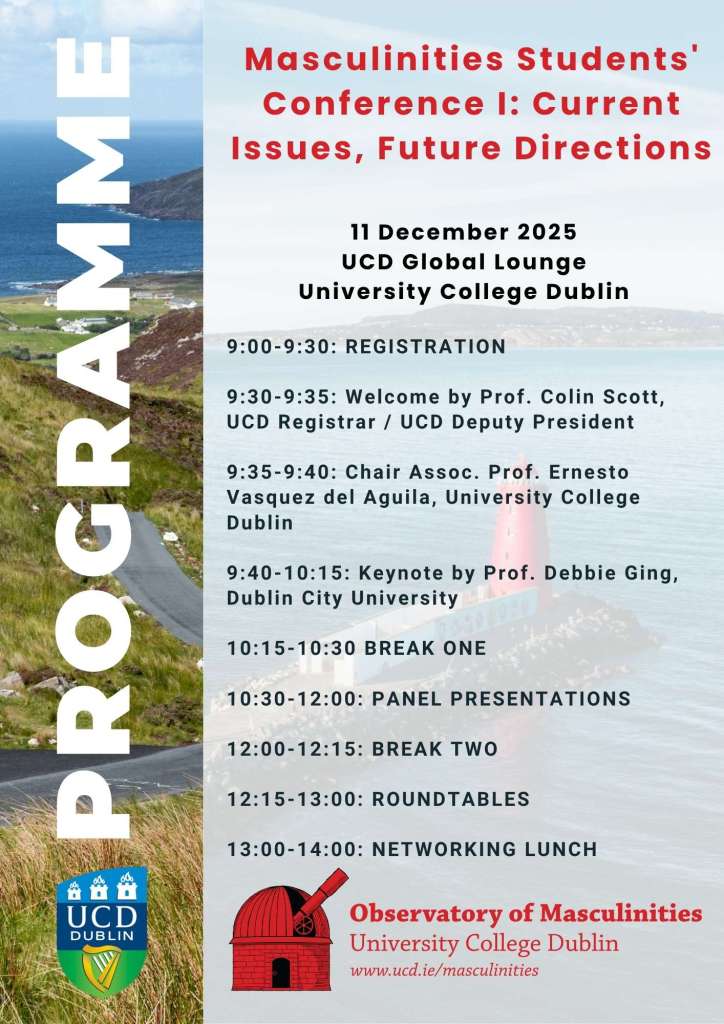
The Observatory of Masculinities hosted the first-ever masculinities-focused student conference at University College Dublin on the 11th of December 2025. Prof. Colin Scott opened the conference, and the Director of the Observatory of Masculinities, Associate Professor Ernesto Vasquez del Aguila, chaired the event. Prof. Debbie Ging from Dublin City University delivered a keynote address on current challenges across the manosphere. The conference was attended by more than sixty participants from Ireland, UK, Canada, Spain and Italy. Students, academics, researchers, and activists met for a half day of research presentations, posters, roundtable discussions, networking, and vital conversations in the study of men and masculinities. The full conference programme can be viewed on the Observatory of Masculinities website.
KEY WORDS
masculinities, conference abstracts, The Observatory of Masculinities, manosphere, CSMM
Oral Presentation Abstracts
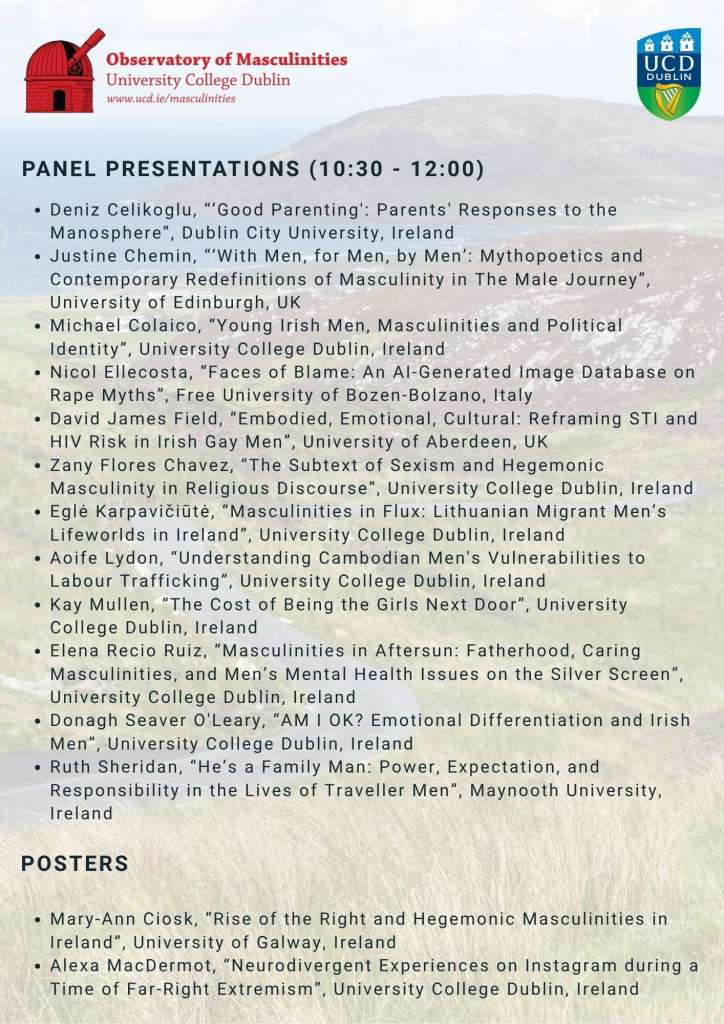
Title: ‘Good Parenting’: Parents’ Responses to the Manosphere
Presenting Author: Deniz Celikoglu
Affiliation: DCU Anti-Bullying Centre
This study examines how parents of young boys navigate the presence of male-supremacist and anti-feminist content online, drawing on the concept of cruel optimism (Berlant, 2011) to illuminate the attachments, anxieties, and contradictions that shape their experiences. This lens offers an understanding of the attachment to fantasies of control and security within the familial context. The study highlights the difficulty parents face in identifying if, and to what extent, their sons are influenced by male-supremacist ideologies. This challenge unfolds within a broader sociocultural landscape where neoliberal promises of freedom, responsibility, and self-making intersect with manosphere narratives, creating the blurred boundaries that parents must navigate. The analysis also considers how the algorithmic structuring of online platforms complicates the expectations of ‘good parenting’, demanding new forms of digital expertise. By focusing on parents’ perceptions and strategies, this work highlights the affective, ordinary, and often contradictory ways that masculinities and patriarchal norms are reproduced, contested, and negotiated in family life.
Title: ‘With men, for men, by men’: Mythopoetics and Contemporary Redefinitions of Masculinity in The Male Journey
Presenting Author: Justine Chemin
Affiliation: University of Edinburgh
Male Journey is an organisation founded in 2015 in the United Kingdom and based on the ideas of American Franciscan Friar Richard Rohr (b.1943). It advertises local men’s groups across the country —inviting men to embark on a journey for a ‘mature, deeply rooted and integrous sense of their true manhood.’ They implement spiritual practices such as council, rites of passage and all kinds of rituals to open the discussion about what it means to be a man today. These practices are more particularly characteristic of the mythopoetic men’s movement, born in the 1980s in the United States. The movement has helped design a male spirituality, hoping to respond to a presupposed masculine malaise. My PhD project aims to examine how mythopoetic practices, as integrated by The Male Journey, participate in sacralising masculinity to facilitate healing and solace for men’s inner wounds. The creation of a sacred masculine identity also raises the question of gendered politics and how to locate it more precisely on the spectrum of pre-existing and traditional discourses on masculinities.
Continue Reading
Title: Irish Men, Masculinities and Political Identity
Presenting Author: Michael Colaiaco
Affiliation: University College Dublin
My PhD research focus which I’ll be presenting on is titled Irish Men, Masculinities and Political Identity. It is a study based on walking interviews with 10-15 Irish Men between 18 and 25 years of age. The study is meant to investigate how their masculine have trajectories developed in the context of rising political extremism in Ireland, the influence of family, friends, peers, role models and online personalities/ ‘manfluencers’ on their identity, political beliefs, and concept of manhood, and how Irish men negotiate both hegemonic masculinity and more inclusive forms of masculinity such as caring masculinity within their own lives. I will present on my theoretical framework, including CSMM, Hegemonic Masculinities, and Caring Masculinities. I will also present on my methodological framework and how I hope to get an idea of young Irish men’s lived experiences and the importance of place and community in identity formation through walking interviews. I will outline the history of masculinities studies in Ireland and how I hope to contribute to the field with my research.
Title: Faces of Blame: An AI-Generated Image Database on Rape Myths
Presenting Author: Nicol Ellecosta
Affiliation: Free University of Bozen-Bolzano
When discussing ‘rape myths’, we are referring to prejudices and stereotypes concerning both victims of sexual violence and perpetrators (Burt, 1980). Based on these premises, various scales have analyzed the pervasiveness of these myths in different cultures and institutions over the years. However, none of them have considered the role of the social background or visual appearance of the people involved, despite these characteristics having a clear impact on the judgment of public opinion, the media, and the judiciary regarding cases of sexual violence (Manne, 2018). This study aims to fill this gap by creating a database of images generated using artificial intelligence (AI: Midjourney v7.0). The AI is useful for creating similar items with higher control over real pictures. This database will help analyze the aesthetic factors that people ascribe to whom rape myths are most often directed, and what visual characteristics might lead a person to be perceived more frequently as an aggressor. This approach allows us to examine not only the spread of myths, but also their dynamics in relation to physical appearance and social context.
Title: Embodied, Emotional, Cultural: Reframing STI and HIV Risk in Irish Gay Men
Presenting Author: David James Field
Affiliation: University of Aberdeen
Sexual health among gay and bisexual men has long been framed through behavioural surveillance and biomedical outcomes, often positioning them as ‘high risk’ populations and obscuring how risk is lived and negotiated in context. Interpretative Phenomenological Analysis of in-depth interviews with nine Irish gay men (mid-20s–early-60s) with diverse relationship contexts and prevention strategies (daily/event-based PrEP, Doxy-PEP, condoms, mixed). Analysis proceeded idiographically before cross-case synthesis; reflexivity was supported through field notes, supervisory dialogue, and the first author’s dual role as clinician/community member. Three experiential themes emerged. Embodied risk: illness, injury and prevention were felt through the body, reshaping practices and identities. Emotional risk: fear, intimacy and validation often weighed more than infection itself. Cultural risk: heteronormative stigma and intra-community hierarchies influenced disclosure, desirability and belonging. Humour, metaphor and tonal shifts For gay men, sexual-health ‘risk’ is not only biomedical but embodied, emotional and cultural. Practice may benefit from moving beyond checklist assessments towards collaborative conversations that surface meanings, vulnerabilities and strengths, supporting person-centred, stigma-aware care and shared decision-making in STI/HIV prevention.
Title: The Subtext of Sexism and Hegemonic Masculinity in Religious Discourse
Presenting Author: Zany Flores Chavez
Affiliation: University College Dublin
This paper examines the inherent duality within mainstream religious discourses, exploring how, beneath an overt message of love and harmony, mandates that institutionalise male authority and dominance often lurk. Religion legitimises hegemonic masculinity by positioning men as the unquestionable ‘head of the household’ and earthly repository of divine power. Crucially, this theological architecture of power is in stark contradiction with its own central precepts of charity and neighbourliness, revealing a fundamental ethical fissure within these institutions. In this presentation, we will explore how this ethical duality manifests in discrimination against women, whose status is often codified as inferior, as well as non-heteronormative identities, challenging the purported universality of divine benevolence and social justice. The study focuses on how religious interpretations shape the prescribed male ‘ought-to-be’ or obligatory conduct and provide a powerful justification for patriarchal control. Revealing this manipulation of sacred text—where the esoteric message differs sharply from the enforced imposition—is crucial for understanding how this contributes directly to structural violence and persistent gender inequality. It is concluded that a critique of this duality is an unavoidable step toward dismantling the religious foundations of masculine domination and reorienting future masculinities scholarship.
Title: Masculinities in Flux: Lithuanian Migrant Men’s Lifeworlds in Ireland
Presenting Author: Eglė Karpavičiūtė
Affiliation: University College Dublin
Critical debates on men and masculinities are becoming increasingly central within social sciences. Scholars point at the rise of digital misogynist ecologies – known as the manosphere – linked to men’s social isolation, radicalisation, and violence (Gerrand et al., 202). An urgent need emerges to examine overlooked masculinities and their connections with extremist online networks. This necessity is especially evident regarding migrant men whose personhood is challenged by transnational mobility, resulting in patriarchal masculine trajectories (Leszczyńska et al., 2024), which makes migrant men susceptible to misogynist and anti-feminist ideologies. Accordingly, this paper responds to the lack of research on Eastern European migrant masculinities and their relationship with the manosphere. It focuses on exploring Lithuanian migrant masculinities, paradoxically entangled within the opposite extremes of male hegemony and marginalisation (Tereškinas, 2011, 2012). These postcolonial masculinities embody an economically driven and socially insular east-to-west migration trend (Gilmartin et al., 2009), overlooked within masculinities and digital violence studies. Consequently, this paper aims to establish a link between Lithuanian migrant masculinities and anti-feminist digital ecologies, as a base for an ongoing PhD project on gender identities and social relationships within the online/offline lives of Lithuanian migrant men in Ireland, aged 18-25.
Title: Understanding Cambodian Men’s Vulnerabilities to Labour Trafficking
Presenting Author: Aoife Lydon
Affiliation: University College Dublin
This paper critiques an existing case study which analyses the trafficking of Cambodian men onto Thai fishing boats to demonstrate a possible pitfall of conducting study on an underrepresented issue; applying a Western framework to trafficking issues in the global south risks analyses skewered by (unconscious) colonial perceptions. This paper subsequently explores labour trafficking in Cambodia within its own context to reveal what effect hegemonic masculinity plays amongst this complex issue. Cambodian men strive to maintain a ‘breadwinner’ role or ‘provider’ identity which places them into vulnerable and precarious situations of—often repeated—trafficking. This paper then continues to suggest how adaptation of such a facet of masculinity studies could be utilised by NGOs working to prevent trafficking and rehabilitate those who have been trafficked.
Title: The Cost of Being the Girls Next Door
Presenting Author: Kay Mullen
Affiliation: University College Dublin
This paper will explore how The Girls Next Door reality television show exemplifies the link between gender performance and access to celebrity and capital success under capitalism, with a focus on precarity, overconsumption, and patriarchal control. The show, which aired from 2005 to 2010, followed Hugh Hefner and his three live-in girlfriends at the Playboy Mansion and offered a stylized, commercialized glimpse into their daily lives. However, beneath the veneer of luxury and fame, the show reveals how women’s success and visibility were conditional upon their adherence to rigid gender roles, sexualized stereotypes, and a hierarchical power structure dominated by Hefner. Drawing from the work of Ariel Levy on raunch culture and post-feminism, this paper will argue that the show frames the performance of femininity as a form of labour, unpaid, precarious, and emotionally taxing, that maintains male power and enriches Playboy Enterprises. The paper will analyse Hugh Hefner’s portrayal as a model of capitalist masculinity, where power, control, and overconsumption affirm his dominant status. Through character analysis of Holly Madison, Bridget Marquardt, and Kendra Wilkinson, the paper will examine how each woman’s assigned role within the mansion dictated not only their access to wealth and celebrity, but also their long-term financial and emotional security. Ultimately, this paper aims to reveal how The Girls Next Door serves as a cultural artifact that underscores the cost of feminine success under capitalism: a life of performance, instability, and commodification in exchange for proximity to power.
Title: Masculinities in Aftersun: Fatherhood, Caring Masculinities, and Men’s Mental Health Issues on the Silver Screen
Presenting Author: Elena Recio Ruiz
Affiliation: University College Dublin
Engaging with masculinities theory, this article analyses the film Aftersun (2022), directed by Charlotte Wells, and its contribution to the representation of the plurality of masculinity and fatherhood in popular media. Media portrayals of fatherhood have tended to present fathers and masculinity from a limiting and monolithic perspective that does not acknowledge its multiplicity. However, the complex depiction of masculinity in Aftersun transcends reductive portrayals of ‘breadwinner’ or ‘protective’ fathers, instead demonstrating a multilayered performance of fatherhood that is linked with vulnerability and caring, while also navigating masculine norms such as repressed emotions. Analysing the character Calum, this article explores the internal conflicts of masculinity that this father experiences, revealing tensions between tenderness and societal expectations of strength. By exploring this film through a masculinities theoretical framework, this article argues that Aftersun works to reconstruct the traditional paternal figure and contribute to broader dialogue around masculinity and mental health.
Title: AM I OK? Emotional Differentiation and Irish Men
Presenting Author: Donagh Seaver O’Leary
Affiliation: School of Psychology, University College Dublin
Emotional Differentiation (ED) is the ability to label one’s emotion state at any given time with specificity and clarity (Barrett et al., 2001). Although it has been shown that ED ability is related to effective emotion regulation (Barrett et al., 2001; Kashdan et al., 2010; Tong & Keng, 2017; Kalokerinos et al., 2019), past research has been criticised for an over-reliance on single-answer and closed-label response formats that do not account for the complexity of ED (O’Toole et al, 2020; Thompson, Springstein & Boden, 2021; Hoemann et al., 2023; Park et al., 2023). It has thus been argued that future ED research should account for such complexity by using qualitative methods where possible (Kashdan et al., 2015; Ottenstein & Lischetzke, 2019; Williams & Uliaszek, 2021; Shiota et al., 2023; Hoemann et al., 2024). The central aim of this research was to investigate the lived experience of nine Irish men as they engaged in ED, and its implications for effective, research-informed mental health interventions. Hermeneutical Phenomenological Analysis (van Manen, 1990/2016) was employed to construct four key themes from interview data: (1) The Process of Emotional Differentiation, (2) The Limits of Language in Emotional Expression, (3) Emotional Differentiation in Practise and (4) The Social Nature of Masculine Emotional Expression. The findings spoke to the multi-faceted nature of ED as it is embedded in the broader and socially-mediated domain of emotional experience. Outcomes from the study pointed to the potential of applying Mindfulness Based Interventions for improving ED, and to the efficacy for qualitative approaches in ED research and measurement.
Title: He’s a Family Man: Power, Expectation, and Responsibility in the Lives of Traveller Men
Presenting Author: Ruth Sheridan
Affiliation: Maynooth University
He’s a Family Man is a qualitative study that centres Traveller men’s voices to deepen understanding of Traveller masculinity and inform more culturally responsive educational and social policy. The research explores how Traveller men understand and enact their roles and responsibilities within the family unit, and how these positions shape their identities, mental health, and engagement with their children’s education. In many Traveller families, men are regarded as key decision-makers, occupying positions of authority and influence; however, this status also brings significant responsibility, with strong expectations to provide, protect, and uphold cultural traditions. Through in-depth, semi-structured interviews, the study examines how Traveller men negotiate these cultural roles, manage associated pressures, and make decisions that affect family wellbeing and educational pathways. The findings aim to challenge deficit narratives, highlight strengths and complexities, and contribute to more culturally grounded educational supports and policy approaches.
Poster Presentation Abstracts
Title: Rise of the Right and Hegemonic Masculinities in Ireland
Presenting Author: Mary-Ann Ciosk
Affiliation: University of Galway
As part of the EMMELO project (European Men, Masculinity, and Extremist Leadership Online), the current research explores the extremist landscape of Ireland through a gendered lens, drawing on historical, sociocultural, and civil society perspectives. Since COVID-19, Ireland has experienced a rise in extremist activity, with migrants identified as the primary target group. Extremism has become increasingly mainstream, reinforced by online mis- and disinformation and gendered narratives portraying men as protectors of women and the nation. These narratives intersect with anti-feminist, anti-LGBTQ+, and anti-migrant discourses, positioning social progress as a threat to traditional identities. Socioeconomic hardship, particularly the housing crisis, has created fertile conditions for far-right mobilization, while hegemonic masculinity is harnessed to foster emotional responses to the perceived crisis of immigration. Through algorithms designed to increase engagement, digital platforms promote polarization. Effective counter-strategies include offline engagement, community-led interventions, critical thinking education, and non-confrontational dialogue. Long-term, sustained funding and policies that address structural inequalities and strengthen social cohesion are essential to reducing Ireland’s vulnerability to extremist narratives.
Title: Neurodivergent Experiences on Instagram During a Time of Far-Right Narratives and Dominance
Presenting Author: Alexa MacDermot
Affiliation: University College Dublin
This project poster examines social media posts about neurodiversity and masculinity on Instagram during a period where global far-right narratives are reshaping the world. The online neurodivergent community has a reputation for group support and for facilitating positive attitudes and awareness about neurodiversity. The far-right is concerned with rewinding social progress and denying support to EDI groups. This may affect how neurodivergent-led social media chooses to position itself. The next years will likely hold great political and social changes for the global community, and neurodivergent online groups may find unique ways to continue to support each other. The findings from this project will contribute to disseminating the positive advocacy for neurodivergent-led support online. This project relates to the disability visibility mantra of ‘nothing about us, without us.’
©The Observatory of Masculinities 2025. This article is licensed under a Creative Commons Attribution 4.0 International License.
 SEXTANT: masculinities, sexualities & decolonialities